ASC's Intersections Newsletter — August 13, 2026
🎧 Listen to this article
Nora's Note
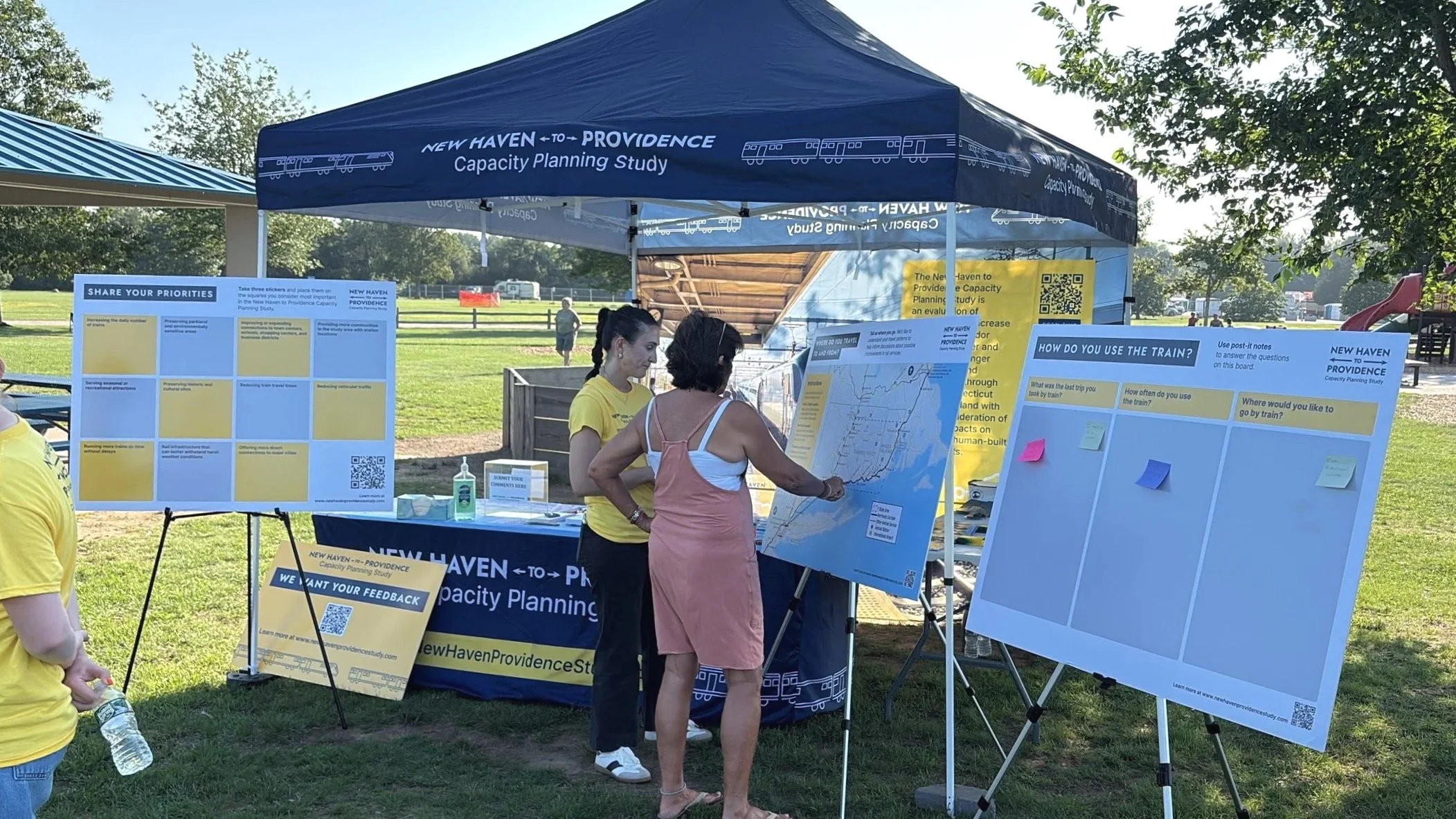
The Best Place to Hear from a Community Isn’t Always a Meeting Room. On August 6, ASC joined the New Haven to Providence Capacity Planning Study team at Thursday Summer Nights at Ninigret Park in Charlestown, Rhode Island. With live music, food vendors, families, and a children’s movie filling the park, the team had a chance to connect with people where they were already spending their evening. ASC facilitated four quick, interactive activities inviting people to share how they travel through the region, what they value in transportation, and what they’d like to see improved. People could stop for a few minutes, share a perspective, ask a question, and get back to the fun. That’s the value of taking engagement beyond the traditional public meeting. It makes participation easier, reaches people who might not otherwise get involved, and creates space for more informal conversations.
The New Haven to Providence Capacity Planning Study is evaluating alternatives for preserving and improving Northeast Corridor rail capacity and performance. There is no preconceived preferred alternative alignment or set of improvements, and the Study is limited to conceptual design and analysis of alternatives. For us, Ninigret Park was a good reminder: sometimes better engagement simply starts by showing up where people already are.
Transportation
A group of New York City ferry workers unanimously voted to unionize, hoping to gain higher pay and increased benefits. The group of 65 workers, made up of technicians and welders, voted to join the Transport Workers Union (TWU) on Thursday evening. For the TWU, the decision represents a key victory in its efforts to recruit workers in the NYC ferry ranks. The organization hopes that this milestone will lead to similar decisions among other NYC ferry employees in the near future. Read more about the decision to unionize. (Source: AMNY)
Gothamist: Baby on board: MTA to make room for strollers on all NYC buses
Mass Transit Magazine: Amtrak makes accessibility, passenger experience upgrades at three stations across the US
Streetsblog: Report: Building more homes reduces overall driving
Climate
In Portland, a small nonprofit is transforming pavement into gardens while advancing environmental justice. Since 2008, grassroots nonprofit Depave has converted 8.4 acres across 80 sites, prioritizing communities facing greater heat exposure and limited access to green space. By mobilizing volunteers to replace asphalt with gardens, small-scale community action is delivering benefits such as carbon sequestration, improved soil drainage, and reduced heat. Read more about how Depave is scaling this model beyond Portland. (Source: Happy Eco News)
Inside Climate News: Pennsylvania confronts an unfamiliar climate hazard: Wildfire smoke
Grist: In a first, Utah got more power from solar that any other state
Canary Media: Virginia lays groundwork to combine more solar with farming
Economic Development
Eight nonprofit organizations, including two in Brooklyn, have received $10,000 grants to advance economic opportunity and civic engagement programming. United for Brownsville will use the grant to support its capacity building program for leaders who encourage civic participation among local parents/caregivers, while the Red Hook Initiative will use its funding for green energy workforce development. Read more to learn about other recipients of this funding. (Source: Brooklyn Paper)
Waging Nonviolence: The inside-outside strategy behind New York’s rent freeze
Philadelphia Today: Philadelphia bets $6B the Navy Yard can become its next neighborhood
Smart Cities Dive: $20B in federal climate grants unblocked by appeals court
Digital
The next big piece of energy infrastructure might be sitting beside the house. Base Power, a Texas startup, is installing large home batteries that do more than keep the lights on during an outage. When demand on the grid spikes, those batteries can send stored power back into the system, turning thousands of individual homes into a distributed source of energy. The company recently raised another $1 billion to scale the model. It is a clever shift in thinking about infrastructure. Instead of solving every capacity problem with another power plant or transmission line, Base is building a network out of equipment spread across ordinary homes. As electricity demand grows, that kind of distributed approach could become an increasingly important part of how the grid keeps up. Read more about home batteries here. (Source: TechCrunch)
Route Fifty: How the Texas transportation department has embraced AI
GovTech: For detailed maps of its service area, CAL FIRE turns to AI
Forbes: How artificial curiosity changed the question humans need to ask
About Arch Street Communications
At ASC, we help government agencies, corporations and nonprofit organizations across the globe communicate issues that affect people’s lives. We’re the bold, nimble, women-owned small business (WBE) that has supported strategic communications programs to build stronger communities for 30 years.
Ready to find the “simple truth” solutions to build a better future? We want to hear from you! Get in touch to learn how our signature approach can work for you.
Subscribe to Arch Street Communications' Newsletter Intersections