ASC's Intersections Newsletter — February 20, 2026
🎧 Listen to this article
Nora's Note
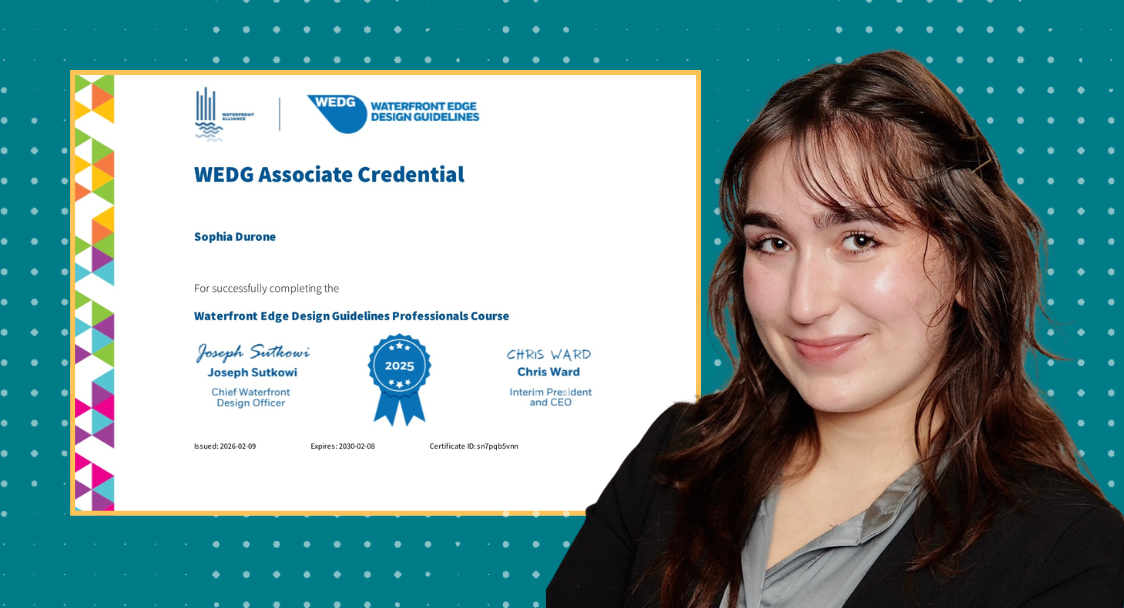
Investing in Expertise, Delivering Impact. Congratulations to Sophia Durone on earning her Waterfront Edge Design Guidelines (WEDG) certification—an achievement that strengthens our ability to support resilient, accessible, and community-centered waterfronts that respond to climate risk and evolving public use. At ASC, continuing education is more than professional enrichment; it produces measurable impact. Research consistently shows that workforce upskilling drives higher productivity, stronger project performance, improved client outcomes and long-term retention—benefits that directly translate into better service delivery and stronger partnerships. At ASC, we believe strong public engagement and smart infrastructure communication are best delivered by informed professionals who understand both policy and place. That’s why continued education is not a box we check—it’s a core value supported by a professional development fund available to every employee.
Sophia joins a growing list of team members who have advanced their expertise this year:
Layla Pluhowski and Alexia Makrigiannis, IAP2USA Designing Public Participation Certificates
Khanh Tran, completing AI in UX Design and Vibe Coding Camp
Alyssa Rivera, Climate Justice Leadership Certificate
Suzanna Lloyd, completing LEED Green Associate
Olivia Macieik, Certified Associate in Project Management (next month)
Polly Lasch, Certificate in Work Management Core
Congratulations to all for modeling the growth mindset that defines ASC.
Transportation
Local officials endorse the Bipartisan BASICS Act, investing in transportation infrastructure. Introduced by U.S. Representatives Kristen McDonald Rivet (D-MI) and Rob Bresnahan (R-PA). Endorsed by eight leading local and regional government organizations, the legislation focuses on local bridge repair, road safety, and community-driven infrastructure priorities. This will strengthen flexible funding and accountability for local projects selected. Supporters, including the National League of Cities and National Association of Counties, argue the bill would better direct federal dollars to regional needs, particularly benefiting rural communities that have limited access to transportation funding. Learn more about investing in transportation infrastructure here. (Source: Transportation Today News)
Mass Transit Mag: NY: Legislatures renew push for commuter trains on west side of Hudson River
Gothamist: Gateway Hudson Tunnel funding resumes with $30M payment
Streetsblog: This Bill would give your community more money to build its own transportation future
Climate
NineDot Energy raises big money for small batteries in New York City. A $431 million financing package will fund 28 community-scale battery projects totaling 494 megawatt-hours, enough to serve roughly 100,000 New York City households during peak demand while supporting the state’s 2030 clean energy and storage targets. These distributed batteries help avoid new fossil peaker plants and can deliver over $60 million in bill credits to low-income customers through statewide programs. Read more to learn how community batteries, urban storage policy, and Statewide Solar for All are reshaping reliability and equity in the city. (Source: Canary Media)
Grist: What’s geologic hydrogen? What to know about the clean energy source buried under Michigan.
Inside Climate News: Retired EV batteries scored a new gig: Bolstering Texas’ grid
Costal Review: With court relief, work resumes on Virginia offshore wind
Economic Development
Factory-built housing is back in the spotlight as California lawmakers grow increasingly “modular-curious” amid a deep affordability crisis. After decades of failed efforts, from HUD’s 1970s Operation Breakthrough to the high-profile collapse of Katerra, Assemblymember Buffy Wicks is advancing hearings and forthcoming legislation to streamline off-site construction. Proponents argue factory production could cut timelines and reduce costs, while skeptics warn of financial, regulatory, and labor hurdles. With Sweden offering proof of concept, policymakers are exploring whether standardization, risk-sharing, and pipeline support could finally industrialize housing at scale. A growing number of policymakers, developers, and investors across the U.S. are revisiting factory-built housing as rising construction costs, labor shortages, and persistent housing deficits renew interest in industrialized approaches once dismissed as impractical. Read more about factory-built housing in California here. (Source: Los Angeles Times)
Smart Cities Dive: NYC commits to $1B expansion of its automated traffic safety enforcement program
The City: Street vendors party to celebrate historic city reforms
NYS Gov: Hochul unveils downtown Albany strategy to guide $200M in high-impact investments and revitalize the capital city’s core
Digital
Recent efforts from the National Institute of Standards and Technology (NIST) are advancing drone technology to better support first responders through indoor location tracking and enhanced situational awareness. These are features traditional GPS cannot provide in complex disaster environments. By deploying drones ahead of emergency crews, responders can assess unstable or smoke-filled structures without immediately putting personnel at risk. With real-time 3D indoor mapping, these drones help identify potential victims and determine the safest and most efficient paths for rescue. As technology evolves, NIST and federal partners are expanding testing initiatives to refine drone performance and solidify their role as essential tools in modern public safety operations. Learn more about lifesaving missions and emerging technology here. (Source: Route Fifty)
GovTech: Massachusetts is deploying an AI assistant for its workforce
Forbes: Better data could unlock AI’s full potential in cybersecurity
Harvard Business Review: Why AI adoption stalls, according to industry data
About Arch Street Communications
At ASC, we help government agencies, corporations and nonprofit organizations across the globe communicate issues that affect people’s lives. We’re the bold, nimble, women-owned small business (WBE) that has supported strategic communications programs to build stronger communities for 30 years.
Ready to find the “simple truth” solutions to build a better future? We want to hear from you! Get in touch to learn how our signature approach can work for you.
Subscribe to Arch Street Communications' Newsletter Intersections